Ergometric Training Concept
A Modern Framework for Structuring the Training Process
By Sergei Beliaev, Founder, Super Sport Systems LLC
The Roots of Contemporary Training Philosophies and Their Ultimate Goals
Over the past several decades, the development of sports training theory has been largely driven by advances in physiology, biochemistry, and performance measurement. These disciplines have contributed significantly to the understanding of how the human organism responds to physical load.
As a result, modern training practice is supported by a wide range of tools and concepts: intensity zones, lactate measurements, interval methods, and various forms of periodization. Each of these elements describes an aspect of performance or a mechanism of adaptation.
However, despite this progress, one fundamental problem remains unresolved.
There is no universally accepted framework that defines the training process as a coherent, structured system.
In practice, training is often organized as a combination of partially connected elements. Coaches apply methods, prescribe intensities, and structure sessions based on experience, interpretation, and convention. Even when based on sound physiological knowledge, these elements do not form a unified system.
As a result, similar methods applied under similar conditions frequently produce different outcomes. Training becomes reactive. Planning lacks consistency. Performance development remains difficult to predict.
This limitation does not arise from a lack of knowledge.
It arises from the absence of a unifying principle capable of connecting all elements of training into a structured process.
Successful Training Process: Desired Characteristics. Why Training Philosophy Matters in Practice
The Ergometric Training Concept defines the principles that explain the logical and methodological interconnection between the main training process elements.
Its origins are not theoretical in nature. The foundations of the concept were developed independently through systemic research of sports training, and was cemented through more than two decades of applying its principles working with thousands of coaches, beginning in the early 2000s with the development of the 3S first generation system. This system was applied across multiple sports and demonstrated consistent performance outcomes.
However, despite early practical success of 3S, one critical issue remained unresolved. It arose from the failure to explain the system’s principles as a whole, still relying on role of its separate components instead of focusing on the unifying principle capable of connecting all elements of training into a structured process.
The system lacked a formal conceptual definition.
The principles that governed its effectiveness were not explicitly articulated. Questions regarding its structure, its differentiation from existing approaches, and the source of its consistency were not answered with sufficient precision.
This absence of formal identity represented a structural weakness.
The system existed as practice, but not as a defined structured framework. This led to confusion and even resistance to 3S concept because its core principles and ideas were not properly explained and therefore, misunderstood.
By 2025, the need for formalization became evident.
The accumulated experience, analytical work, and practical results required a clear conceptual structure. The task was not to create a new method, but to define the underlying principles that had already been applied.
The Ergometric Training Concept represents this formalization. It establishes a framework for understanding training as a structured process of change in the athlete’s condition.
In simple terms, the Ergometric Training Concept treats training as a structured process of designing adaptation over time, rather than reacting to isolated workouts.
It is interesting to note that because ETC evolved from amalgamating several independent components, the world overlooked its existence, focusing instead on its individual components. As a result, the powerful integral value of this concept was missed entirely. This omission further led to the inability to establish common ground and connections between the different process parts. More so, because different training concepts use common vocabulary and general definitions, all concepts are assumed to operate on similar premises, which is a mistake because mixing paradigms lead to reduction of effectiveness if not to total failure.
The significant advantage of the ergometric approach, by contrast, lies in its ability to tie together central components of the training process in a coordinated, coherent manner.
A MAJOR Difference in Perspective
The ETC represents a different Hierarchial level of training philosophy.
In most contemporary approaches, training is understood through its individual components:
- intensity zones
- physiological markers
- training methods
- periodization structures
These elements are often treated as independent tools used to describe or influence performance. In many cases the attempts are made to explain training system as a whole based on a singular element or individual component.
Within ETC perspective, the training process is viewed as a combination of separate parts.
The Ergometric Concept approaches training differently
The Ergometric Training Concept defines training as a structured process, where all elements are interconnected and governed by common criteria.
In this system:
- zones are not independent
- methods are not interchangeable
- and training decisions are not isolated
All components are subordinate to the logic of the process itself.
This distinction is important.
When a process-based system is evaluated from an element-based perspective, its structure may not be fully recognized.
Individual components may appear familiar, but their role, interaction, and purpose within the system are fundamentally different.
As a result, attempts to interpret or apply the Ergometric Concept using conventional frameworks can lead to misunderstanding, inconsistency, and reduced effectiveness. To function properly, the system must be applied within its own framework.
What is the Ergometric Training Concept?
The ergometric training concept is based on a power-time of maximum effort dependency. This describes the phenomenon of power reduction as effort time increases. Since energy production mechanisms define power production, duration of effort can be directly connected to physiological markers, such as Heart Rate, oxygen consumption, lactate accumulation, etc. This also means that we can use the duration of effort as the universal parameter across all elements of the training process, from evaluation of initial ability to precise calculation of training targets for each training set we use, at any point in the season.
To summarize,
the Ergometric Training Concept is a scientifically structured training system that defines and manages the relationship between effort, time, and resulting power output in order to design, control, and predict the athlete’s adaptation and performance development.
At the core of the Ergometric Training Concept lies a fundamental premise: Training is not a collection of methods.
It is a process.
More precisely, it is a process of controlled transformation of the athlete’s functional state, directed toward a defined performance goal. This process is governed by the relationship between load, time, and adaptation.
Unlike traditional approaches, where training variables are often treated independently, the Ergometric Concept defines a system in which all variables are interconnected through common criteria.
The central element that enables this integration is time.
Time as an Integral Criterion of the Ergometric Training Concept
Time functions within the training process in multiple dimensions.
- It defines the duration of effort, and therefore the relationship between power and work.
- It determines the cumulative exposure within specific energy zones.
- It structures the distribution of load across days, weeks, and phases of preparation.
- It serves as the primary measure of performance itself, expressed as time over a given distance.
Through these roles, time becomes not simply a parameter, but the organizing dimension of the entire system.
It allows physiological, mechanical, and methodological elements to be unified within a single framework.
Adaptation as a Central Parameter of management under Ergometric Training Concept
A critical distinction of the Ergometric Training Concept lies in its treatment of adaptation.
In conventional models, adaptation is often viewed as a response to individual training sessions. Load is applied, and the organism reacts. This creates a two-dimensional interpretation of the training process: effort and response.
However, performance does not develop through isolated reactions. Adaptation is the result of repeated exposure to structured loads over time.
This recognition of adaptation as a process developing over repeated exposure to structured loads introduces a third dimension to the training process — the progression of change over time.
Within this perspective, parametric training principles become applicable, where different structures of load produce different, but predictable, directions of change in the athlete’s condition.
The foundations of parametric training principles and their associated modalities were established in the late 1970s within the field of sports methodology. These principles defined adaptation as a function of structured load applied over time and introduced the concept of directional development through specific training strategies.
However, these principles were not widely adopted in Western training practice.
One of the reasons for this was their incompatibility with the dominant frameworks of the time, which remain influential in mainstream coaching to this day, despite ongoing efforts to rethink the purpose and structure of sports training.
On one side, training systems based on anaerobic threshold concepts emphasized the use of physiological markers as primary regulators of intensity. This interpretation was later critically reassessed by A. Mader, the originator of the anaerobic threshold method, who acknowledged the limitations of linking lactate values directly to training regulation in a universal manner.
On the other, classical periodization models used fixed training cycles without linking them to measurable or dynamic rules of adaptation.
Parametric principles, which describe adaptation as a function of structured load applied over time and through defined strategic modalities, did not align with either of these approaches.
As a result, despite their conceptual significance, these principles were not incorporated into structured training systems and remained largely absent from practical application in the broader coaching field.
At the same time, parametric principles continued to be developed and applied within the 3S system, where they formed one of the foundational elements of training design. Over more than two decades of practical work, these principles were tested, refined, and extended within applied coaching environments.
This work, led by Dr. Sergei Beliaev, contributed to the preservation and further development of parametric approaches within a functioning training system, even though their role remained implicit and not formally defined as an independent methodological framework.
The formalization of the Ergometric Training Concept represents a further step in this development, providing a clear conceptual structure that defines the role of parametric principles within the overall organization of the training process.
Core Elements of the Ergometric Concept
1. Individual RESULTS STRUCTURE (“Energy Portrait”)
This concept evaluates each athlete’s unique “preparedness structure” through discrete maximum level efforts on different distances that require participation of different energy pathways. Instead of generic training prescriptions, this approach identifies the unique relationship between maximum speed vs. endurance abilities of the individual, allowing tailored interventions based on their actual physiological profile.
Real-World Application: A sprint-oriented swimmer with powerful anaerobic capacity but more limited aerobic endurance, requires fundamentally different training than an endurance-dominant athlete–even if they compete in the same event. The Energy Portrait provides the exact map of these differences for the respective athletes and offers guidance for a more effective training plan.
2. Ergometric Energy Zones
The 3S Energy Zones are defined by the duration of full-out efforts and corresponding power outputs, mapping directly to the body’s energy systems. This contrasts with traditional zone models (whether lactate or heart rate-based), which typically lack precision in zone boundaries which leads to failure to match the effort (sets) with target training goals at any point in the training cycle.
Real-World Application: Instead of prescribing “Zone 2” work based on a percentage of maximum heart rate, the Ergometric approach calculates specific durations and intensities tied directly to the energy system, making each training set precise and effective, with measurable impacts on performance.
3. Parametric Training
This approach models the long-term effects of specific training modalities, isolating “progression constants”–key to understanding and predicting adaptive responses to specific workloads across different training patterns.
Real-World Application: Understanding that different types of training stimuli produce different rates and characteristics of adaptation allows coaches to maximize the development of specific abilities in an optimum sequence, rather than applying the same training load patterns year after year, regardless of results. In essence, Parametric Training introduces a different dimension in training that changes our approach to periodization rules and lays the foundation for contemporary periodization principles.
4. Contemporary Periodization Principles
Moving beyond traditional periodization theory, this approach is based on adaptation laws and progression constants, providing a customized roadmap of training loads, intensity, and recovery for each athlete.
Real-World Application: Instead of rigid macrocycle frameworks, this approach allows for flexible customization of training loads and sequencing, supporting athletes’ target adaptation and energy profile, while also driving to peak performance precisely when needed.
5. Weekly Load Distribution (“Weekly Load Density”)
This component optimizes how training stress is distributed within a micro cycle, ensuring proper recovery and minimizing conflicting effects of stresses pointed to different energy systems.
Real-World Application: Understanding the recovery requirements between different energy system training efforts allows precise scheduling that maximizes adaptation while minimizing systemic fatigue and injury risks.
The role of physiology within ETC framework
The role of physiology within ETC framework is essential, but specific.
Physiology provides core principles of human body functioning under maximum physical stress.
In helps to understand the mechanisms underlying performance, define adequate and effective means to influence their functionality, and suggest methods for evaluation of the athlete’s condition. It also allows the identification of limiting factors of performance and the estimation of required capabilities for achieving a target result.
However, physiology alone does not define the process of the athlete’s condition transformation.
The process of transformation requires a structured methodology, which is a domain the of science known as “Methodology of Sports Science”.
In this sense, sports training extends beyond physiology. It represents a methodological and pedagogical process, in which the coach guides the development of the athlete through controlled application of effective methods that are covering all the elements of the process.
It is also important to note that the athlete is not a static object. The athlete should be viewed as a dynamic system capable of adaptation, learning, and self-regulation.
Training, therefore, is not only a way to manage changes of a biological system. It is a purposefully guided development process.
From Theory to Practice: Why This Matters
The Ergometric model:
- Treats training as a process, where every element is measurable and predictive, removing guesswork from any planning and evaluation decisions.
- Provides forward-looking planning, based on the power demands required for target performances
- Uses physiological markers like Heart Rate, lactate or VO2 for validation, not direction
Properly applying the Ergometric Concept allows one to reach target results with over 90% confidence (as long as the progression goals fall within realistic limits of athlete adaptation). Since Christine Magnuson’s two Olympic medals in Beijing 2008 (under Coach Matt Kredich at the University of Tennessee), the 3S methodology built on the Ergometric Training Concept has put athletes on world-level podiums every single year through 2025. This isn’t coincidence–it’s the predictable outcome of a scientific training framework that transforms potential into measurable, reproducible performance gains.
Comparison: Ergometric vs. Traditional Physiology-Based Models
Feature |
Lactate-Based Model |
Ergometric Training Concept |
| Basis | Physiological test results | Universal Power-Duration dependency |
| Planning | Based on past performance | Based on future performance goals |
| Usability | Invasive, requiring expert interpretation of test results | Universal, simple to use in any environment and at any level |
| Focus | Reaction to training | Pre-calculated training pathways |
| Use of Testing | Directional | Validation and adjustment |
| Outcome Certainty | Moderate | >90% if adaptation limits are respected |
Why This Changes Everything for Coaches and Athletes
With the Ergometric approach, you can:
- Set accurate, personalized training loads expressed in specific working intervals and intensities
- Design workouts that align with specific training needs and real bioenergetic goals
- Avoid overtraining, wasted or misdirected efforts
- Build detailed plans from the seasonal level to daily sets
No more guesswork. No more reliance on “what worked last year.” Instead, you’ll have:
✅ Predictability
✅ Customization
✅ Performance-backed planning
Bringing the Concept to Life
Having a working concept is great, but actually deploying the concept via an easy-to-use and effective practical application is a game-changer. The access to the process planning and each individual element are now accessible through the SuperSportSystems.com platform, where the Ergometric concept algorithms are fully integrated into a coach-friendly interface. Input your athlete’s data and goals, and the system generates the training strategy, progression path, and workouts while still allowing the coach to adjust any parameter and stay in full control of the direction of the process.
While the 3S platform is fully automated, it is also highly customizable. Based on our two decades of experience, understanding the training process components and their interaction significantly influences the success rate.
Having said this, all the way back to Christine Magnuson’s two Olympic medals in Beijing 2008 (under Coach Matt Kredich at the University of Tennessee), the Super Sport Systems (3S) tools and Ergometric methodology has consistently helped coaches and athletes from different countries and sports reach national and world-level podiums every single year through 2025.
Important Points to Remember:
#1 From a practical standpoint, the training process can be described as a sequence of interconnected stages:
- evaluation of the initial condition
- definition of the target performance model
- structuring of training loads over time
- execution of planned work
- monitoring of responses
- adjustment of subsequent actions.
This sequence is continuous and iterative. Its effectiveness depends on the precision of its structure and the consistency of its application.
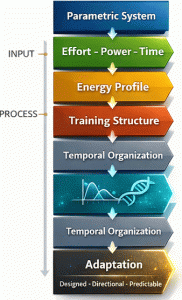
#2. The Ergometric Training Concept does not reject existing scientific knowledge.
ETC incorporates physiological, biomechanical, and methodological principles into a unified system defined by measurable relationships.
Its objective is to transform training from a set of methods into a structured process capable of producing predictable outcomes.
#3. Final Conclusions:
- Performance is not the result of isolated reactions to individual training sessions. It is the outcome of a structured and directed process of change over time.
- The purpose of the Ergometric Training Concept is to define this process. In doing so, it establishes a framework that allows performance development to be designed, rather than approximated.
Final Thoughts: A New Era in Sports Training
If you’re a coach, athlete, or performance specialist looking for a more scientific, results-oriented training method, the Ergometric Concept represents the future of sports science. It respects and welcomes the art of coaching, but arms it with real science and practical tools for everyday use.
In a world where milliseconds matter, training decisions should not be based on guesswork. The Ergometric Training Concept provides coaches and athletes with a model-driven, adaptable, and forward-looking framework that has proven itself at the highest levels of sport.
This approach turns theory into practice and application into podiums by aligning training with an athlete’s energy profile and structuring progressions based on individual adaptation needs.
Ready to train smarter?
Visit SuperSportSystems.com to explore how the Ergometric model can change your approach to training — and your results.