
Connecting Coaching Problems WITH Effective Training Decisions
The purpose of the 3S Summer Webinar Series is to demonstrate how the 3S methodology converts practical coaching problems into effective training decisions.
During our most recent webinar, several experienced coaches from different backgrounds raised questions that, although different on the surface, reflected exactly the same coaching challenge.
In each instance, the questions perfectly illustrated the conceptual process we discussed. Here is one example:
“In light of the 3S position on Energy Zone definitions and the selection of appropriate training intensities, how would you explain the following situation? I observe a 100-yard swimmer maintaining the desired race pace through approximately the first 75 yards before running ‘out of gas’ and no longer being able to sustain the required effort.”
Although the example refers to a 100-yard event, the question itself is universal.
And since 3S represents a unified methodology, it also uses a common vocabulary.
One reason coaches often reach different conclusions when discussing the same subject is that they use the same words to describe different concepts. Terms such as energy pathways, energy system, training target, capacity, zone, lactate, and threshold are frequently used interchangeably, even though they represent different elements of the coaching decision-making process.
The 3S methodology begins by establishing common methodological vocabulary. Not to introduce new terminology, but to ensure that every coaching idea is expressed in terms that have a precise meaning throughout the training process. Based on our observations, this is where the confusion often starts in coaches’ communication and presentations, when presenters and coaches use similar labels for different processes and elements that describe physiological processes and their application in training practice.
3S Methodological Vocabulary
| Term | Meaning within the 3S Methodology |
| Energy Production Mechanism (Energy Pathway) | The energy production mechanism (i.e. “aerobic glycolysis”, etc.) selected as the primary training direction. |
| 3S Energy Zone | The operational representation of that Energy Production Mechanism, identified in terms of time (duration) at which maximum energy output is achieved to support maximal effort at that duration. |
| Training Target | The selected target Energy Mechanism or its fraction (the specific characteristic to be developed – such as process Power, Capacity, Efficiency, etc.). |
| Supporting Mechanisms | Other Energy Production Mechanisms whose development influences the primary training target. |
| Physiological Targets | Measurable physiological expressions (Heart Rate, Lactate, VO₂max, Economy, etc.) used to evaluate adaptation—not to define the training target. |
With this common language established, let us return to the coaching problem.
A coach is looking for a solution to a specific problem, such as the inability to sustain the desired pace to the end of a distance event, and is seeking training decisions (sets, modality, intensity, and duration) that may address the identified limitations.
Every coach has experienced a similar challenge.
In those cases, the important question is not simply to identify what happened.
The important question is: How do we determine the correct training solution?
This is where the 3S methodology begins.
Unlike many conventional approaches that start by selecting workouts or prescribing training intensities, the 3S methodology begins by identifying the appropriate training target.
For example, if our goal is to enable the swimmer to maintain the desired speed throughout the 100-yard event, you should focus on the processes that predominate during that period of maximal effort, which typically lasts between 45 and 60 seconds.
Within the 3S methodology, the duration of maximal effort identifies the predominant Energy Production Mechanism (Energy Pathway) that supplies most of the energy during that effort. That mechanism defines the corresponding 3S Energy Zone by the time of required effort.
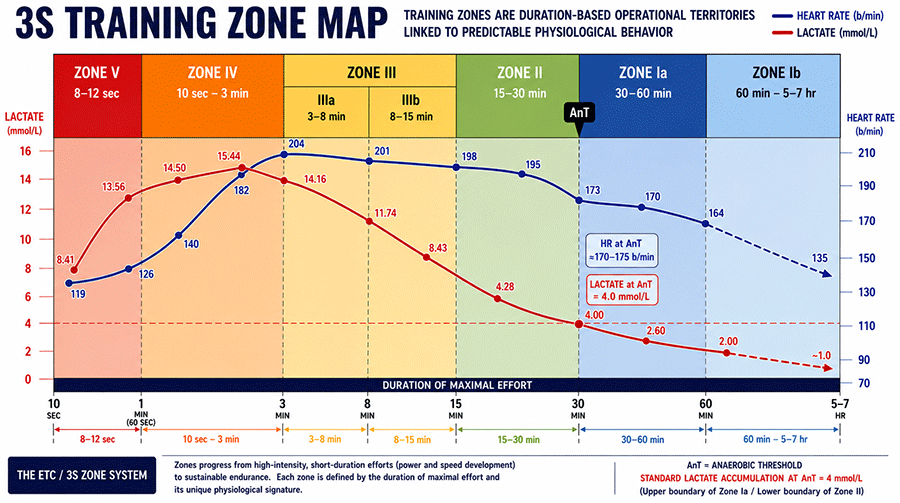
In the 100-yard-distance example, the analysis squarely identifies Zone IV as a primary training target that requires attention.
The next coaching decision follows naturally.
Once we selected Zone IV as our target, which characteristic of that mechanism is more important, given the athlete’s deficiency evaluation?
In our case, the athlete demonstrates the ability to achieve the desired race pace but cannot sustain it through the duration of the event.
The primary training target, therefore, becomes Zone IVb — Anaerobic Glycolytic Capacity.
Once the appropriate training target has been identified, we immediately connect the target with an appropriate training solution that is most effective in this instance.
How do we develop capacity?
The answer begins with the defining characteristics of capacity within the zone in question.
Time or Duration of sustained effort at “critical” speed, where speed can always be interchanged with the power necessary to achieve that speed.
To increase anaerobic glycolytic capacity, the athlete must apply training effort corresponding to the maximum duration of the zone boundary, in our case, at approximately three minutes. Clearly, that coach may want to build this ability within time (weeks), but that is another coaching decision that depends on individual reactions of a specific athlete – a matter of training process management.
Practically, this means modifying the training set to extend the duration of work within the selected Energy Zone. In the case of Zone IV, where the duration of effort extends up to approximately three minutes, this can often be accomplished by increasing the number of repetitions or otherwise extending the total time of effort while maintaining the desired training objective.
Another consequence of this decision is that: as the athlete spends more time stressing the anaerobic glycolytic mechanism, blood lactate concentrations naturally increase, frequently reaching their highest values.
This observation has led many coaches to describe similar workouts as “lactate tolerance training.” The 3S interpretation is fundamentally different. The objective is not to train lactate. The objective is to develop Anaerobic Glycolytic Capacity—the ability to sustain work at the boundary values of a specific Energy Zone.
Elevated lactate is a physiological consequence of correctly targeting and stressing the selected Energy Production Mechanism—not the training objective itself.
This example illustrates something much broader than the solution to a single coaching question.
Once the appropriate training target has been identified, the remaining coaching decisions no longer exist in isolation. Each decision naturally leads to the next.
- The duration of the competitive effort identifies the appropriate Energy Production Mechanism and corresponding 3S Energy Zone.
- The appropriate training target is identified.
- The methodology determines how the target should be developed by modifying the time of effort within the selected zone.
- The resulting physiological responses become consequences of the selected training target—not the target itself.
However, identifying the correct training target is only the beginning of the coaching decision-making process.
Identifying the correct training target and selecting the appropriate exercise solves the immediate coaching problem. The next decision is different. The coach must now determine the most effective path for developing that target. In the 3S methodology, that path is associated with the concept of a training strategy.
The methodology described above is implemented automatically inside the 3S platform.
Each athlete’s targets, training intensities, and weekly progression are recalculated continuously as performance changes.
Request a personal walkthrough and we’ll demonstrate the process using your own athlete or team.