

Note to the reader: The following case examines the real-time progression of performance in relation to the specifically designed structured training.
From Observation to Design
Recent season results across multiple programs show a consistent pattern: Performance improves progressively when training is structured and applied over time.
This observation is further illustrated in the analysis of Henry Wischusen’s performance progression.
The question is no longer whether structured progression occurs — but how such progression can be designed and managed.
Reaching Maximum Performance Is Not Trivial
Reaching peak performance is not easy to achieve at any age.
In sports where power output and stamina define results, the commonly accepted window for optimal performance typically falls between the mid twenties and mid thirties. Beyond that range, physiological decline—particularly in maximal oxygen uptake and recovery capacity—becomes progressively more pronounced, while the ability to achieve peak results declines.
And yet, exceptions occur.
These cases are often discussed, admired, and even envied by those who refuses to age. But rarely such performance is analyzed in a structured way. The question is not simply whether performance can improve beyond expected limits, but under what conditions such improvement becomes possible.
Henry Wischusen’s case provided us with a deep insight not only into building winning abilities, but also in Henry’s on-going physiological response to a 3S GEN2 training program, which was designed (and followed) with a goal to achieve individual peak performance.
Henry Wischusen case study
1. Season Starting Conditions
Henry Wischusen started the preparation for the 2025–2026 indoor championships season not as an emerging athlete, but as a mature competitor with an established performance history. A two-time U.S. National Indoor Champion and a Silver Medal winner at the World Indoor Championship (2023, 2024), he had already demonstrated elite capability, achieving 7.22 result in February of 2024, after the his first training season on the 3S GEN1 platform.
In spite of winning (and achieving very respectable result), Henry’s previous two seasons results dynamics showed only marginal progress which is “expected” at this age. In 2025, Henry’s winning result at age 73, was 7.24, which is consistent with suggested performance decline at rate close to three seconds per year after ~ 65.
2. 2025-2026 Season Results
From my experience working with master athletes across several sports over nearly three decades, one factor consistently proves decisive:
the quality and precision of the individual training program.
Well-structured training architecture can allow athletes not only to maintain performance, but in some cases to improve personal bests far beyond conventional expectations.
We, at 3S, have numerous examples of how structured individual training program can support peak performance. One vivid sculling example is Greg Benning, who began training exclusively using the 3S platform in 2006 and never lost his Champion status at the Heads of Charles regatta since then, including HOCR 2025, at age of 63. At age sixty, in addition to a gold medal in his age category, Greg placed 16th overall, across all participants. All these performances supported by 3S GEN1 platform through this years.
The case of Henry Wischusen III provides another remarkable illustration, now in indoor rowing.
During the current season discussed here, Henry achieved:
- U.S. National Indoor Rowing Championship — Gold Medal
- World Indoor Rowing Championship — Silver Medal
- 7:19.4 for 2000 meters at age 74 (more then 2 seconds faster his own Champion time at age of 72).
These performances raise an important question:
How can results continue to improve at an age when physiological decline is normally expected?
3. What Changed. Transition to 3S GEN2 Platform
To answer this question, we looked at the variables went into Henry’s last season preparation and that were different compared to previous years. The major change in Henry’s preparation was in the version of 3S platform Henry has chosen for that season. In his own words: “3S offered me to move on the new 3S GEN2 Training Design platform. I accepted this offer and it immediately felt difference in precision and structure of my workouts, which better supported my adaptation ability”.
The 2025–2026 season introduced a new variable: transition to the 3S GEN2 training system.
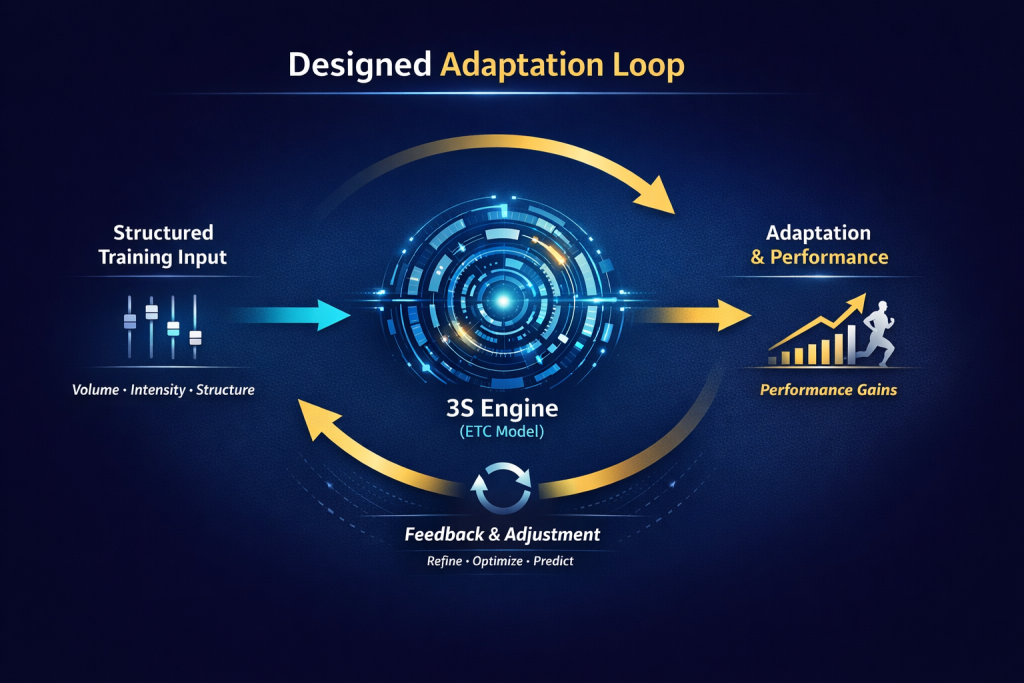
This transition was not about simply increasing volume or intensity. It was about changing the logic of how training loads are designed, distributed, and controlled over time.
The visible difference in performance came not from isolated “harder” sessions, but from a different training architecture. In that sense, we can say that the improvements do not come from effort alone. They require structural change in the training process.
3S GEN2 Structural Architecture Elements
Parametric Load Design
Training is assigned as part of a predefined load structure aligned with long-term adaptation targets.
Energy-Based Modeling
Training zones are derived from the athlete’s individual performance model, not generic markers.
Sequential Load Progression
Load is introduced in a controlled sequence so each phase prepares the next.
Threshold-Centered Adaptation
Adaptation is managed near functional limits rather than through random high-intensity accumulation.
Weekly Load Distribution Control
The system balances density, intensity, and recovery to support reliable progress.
Unified by The ERGOMETRIC TRAINING CONCEPT
The Ergometric Training Concept (ETC) explains how structured training loads, guide the interaction of energy systems, and shape athletic performance.
The 3S platform implements ETC through individualized performance modeling known as the Dynamic Performance Structure aligned with Parametric Training principles.
This allows training loads to be aligned with the athlete’s current adaptation abilities at their threshold and coordinated with future performance goals.
4. Independent Monitoring of Performance Progression
Understanding the risks associated with high-stress training in his age, Henry combined the training prescriptions generated by the 3S platform with independent performance monitoring tool – Pedal Mentor (created by Joel Danzig).
This decision was a game changer not only for Henry, but also for general understanding the influence of highly structured 3S training program can produce in real time.
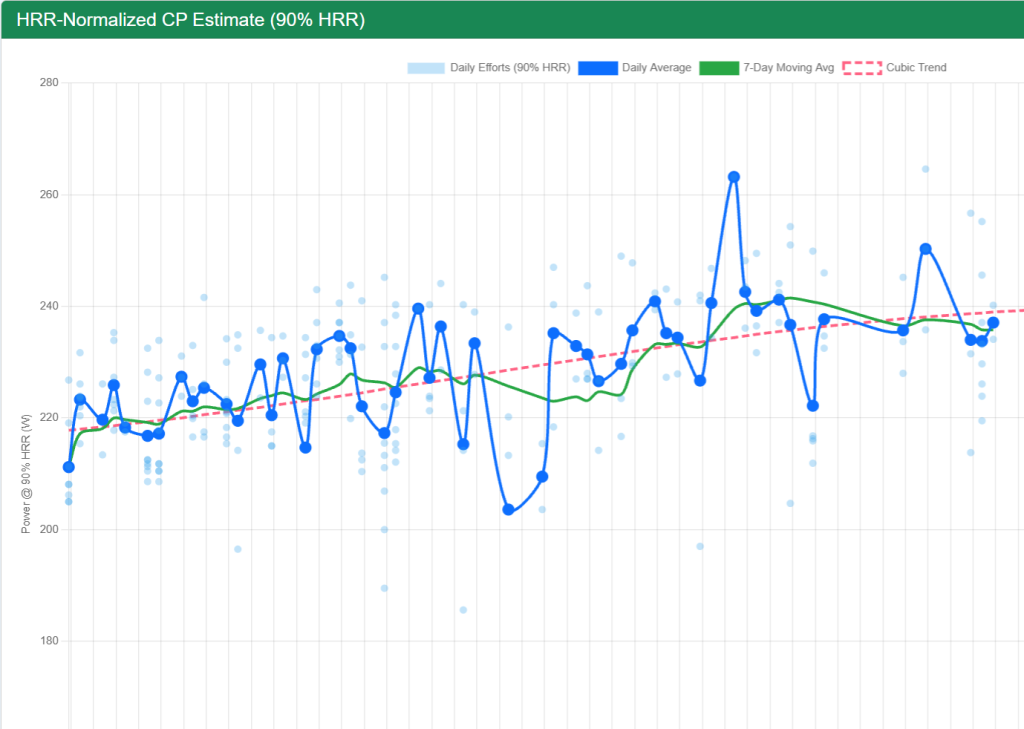
Pedal Mentor analyzed daily workloads actually executed by Henry and provided an additional, external, and independent perspective on his performance progression is several, quite informative graphs.
It is important to note that Pedal Mentor is based on a traditional threshold-oriented methodology commonly used in cycling and is not connected to the 3S training model in any way. This makes the analysis particularly valuable, as it provides an independent evaluation of the observed training response.
Henry Wischusen Training Progression Analysis
(Data courtesy of Henry Wischusen III and Pedal Mentor)
5. Discussion
The Pedal Mentor system evaluated Henry’s executed training using several indicators:
- Blue broken line — average daily training load
- Red dotted line — trend of change of average power capacity
- Green curve — normalized daily power response (converted to a standard 1 km effort)
For this discussion, the green curve, representing the daily response to proposed by 3S workload, is the most informative, as it reflects real-time changes in Henry’s daily work capacity.
What Makes This Example Methodologically Important
The monitoring system used in this analysis was not designed around the 3S methodology. Yet the progression of Henry’s work capacity closely follows the adaptation trajectory predicted by the 3S training design. This is hardly a coincidence.
This suggests that the improvements observed during the season were not accidental. Instead, they reflect the underlying logic of the training architecture:
when training loads are aligned with the athlete’s current adaptation threshold, performance development becomes structured, directional, and sustainable.
Independent analysis confirms controlled progression — not random improvement
Key Observations: Consistent Growth of Work Capacity
The most striking feature of the data is the steady upward trend in the normalized daily power response (green curve), indicating continuous performance improvement across the season.
This progression continued until peak volumes were introduced in the highest-intensity zones.
At that point, a brief deviation appeared, reflecting accumulated fatigue.
Henry responded by:
- introducing one additional recovery day
- slightly reducing high-intensity volume
This small adjustment restored the progression trend, allowing him to complete the season with the performances that secured both national and world championship medals.
Results Trajectory and Adaptation Saturation
The timing of the temporary saturation is particularly informative.
The interruption in the progression occurred at the end of the accumulation phase, when partial loads across several training zones were approaching their planned weekly maximums.
From a methodological standpoint, this is significant:
- If fatigue appeared earlier → loads would likely be excessive
- If no saturation appeared → loads might be insufficient
In this case, saturation occurred exactly at peak planned loads, indicating that the applied training stress was positioned very close to the athlete’s actual adaptation threshold.
This highlights an important characteristic of the 3S methodology:
the training process is designed to operate near the optimal adaptation boundary.
Precision, Risk, and Control
Operating near the adaptation threshold inevitably reduces the margin between productive stress and overload.
The more precise the system, the greater the need for:
- careful monitoring
- timely adjustments
- disciplined execution
Henry’s case demonstrates this clearly.
A minimal intervention — one additional rest day — was sufficient to restore the progression.
This suggests:
- high precision of load design
- robustness of the training structure
- ability to adjust without compromising the overall performance trajectory
Monitoring Methods and Interpretation
The Pedal Mentor system uses a normalized performance index based on a standardized distance.
This provides a useful representation of performance trends, particularly through cumulative daily work.
At the same time, it represents a simplified model compared to the analytical capabilities available within the 3S framework.
The 3S methodology operates with a Dynamic Energy Portrait, which allows:
- estimation of performance across different race distances
- evaluation of energy system contributions
- conversion of executed training data into projected full-effort performance
One concept used by Pedal Mentor — cumulative representation of daily work — is also present in 3S through the Daily Intensity Index, reflecting the overall training stimulus of a session.
Interpreting Fatigue
The data also provide important insight into fatigue.
In practice, fatigue can be viewed at three levels:
- Short-term fatigue
Occurs after individual sessions and is managed through within-day load distribution - Medium-term fatigue
Represents accumulated stress across a weekly cycle and is managed through rest days and training structure - Long-term (chronic) fatigue
Represents systemic overload requiring extended recovery and often compromising the season
Henry’s case clearly reflects medium-term fatigue, not systemic overload.
This is supported by:
- rapid recovery after one rest day
- immediate return to progression
- no negative impact on final performance
This distinction is important:
fatigue and adaptation are related but fundamentally different processes and should be managed accordingly.
6. conclusions: What this case demonstrates
Final Perspective
Henry Wischusen’s season is, first of all, an exceptional personal achievement. But it is also something more.
It just happened that combination of 3S training design platform and Pedal Mentor ongoing performance analysis provided an unexpected and unique opportunity to observe and define how an athlete responds to a training program when it properly designed and applied correctly, consistently, and under conditions where the margin for error is extremely small.
This progression is not unique to Henry.
It reflects a structured training process defined by 3S.
The steady progression, the precisely timed saturation, and the rapid recovery all point in the same direction:
The achieved progression and season-end result was not a random accomplishment.
It was the result of a guided training process designed to operate at the edge of Henry’s individual adaptation abilities — and to remain stable while doing so.
For coaches and athletes, this raises an important possibility: If performance can be guided in this way, then progression does not have to be unpredictable.
In the other words, The Performance can be designed!
From Case to Application: This Is Not an Isolated Exception
Henry’s result is not presented as a one-off story. It is evidence and example of what becomes possible when training is guided by a unified scientific model and managed as a structured adaptation process.
The important point here, that with 3S training concept and much improved 3S GEN2 Training Design Platform, the results are no longer accidental. They are designed and supported by carefully engineered training design.
And, if you compare coaches reports coming from different sports, you may find out that 3S principles are effective across different training environments/sports.