
Recently, Dr. Chris Harnish shared a chart compiled by Dave Bishop comparing how different systems classify training intensities and exercise stress.
The question Chris asked was: “Is this a model you use or will adopt?”
Pic. 1 “Consensus Statement”, Dave Bishop, 2025
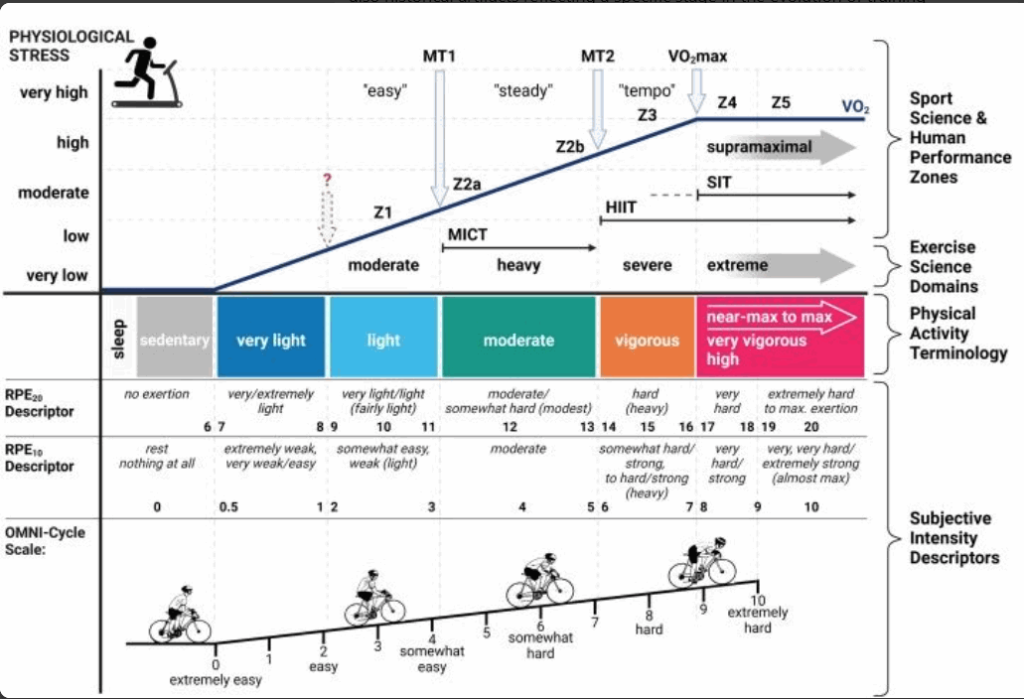
In his post, Chris noted that “Exercise Intensity Terminology is a mess”. Coaches who often move between different systems of zone definitions, intensity corridors, anecdotal methods, and “experience-validated” ideas cannot talk and compare notes if we’re not speaking the same language.
This chart struck me as very revealing of the limitations shared by the current dominant training paradigms and the prevailing training philosophies.
It clearly demonstrated how modern stress classifications — based on physiological severity or subjective intensity descriptors — shape existing training systems and the training ideas as perceived by the mainstream. From this perspective, stress factors become the primary organizational principle of the training process itself.
In other words, this chart reveals that the training process is organized around stress classifications.
What Makes Training Effective
For training to be truly effective and optimized toward a specific performance goal — which is the central challenge of the Methodology of Sports Training — each workload must have not only a specific role (as defined by “intensity level”), but also a specific PLACE in time and direct alignment with the desired result. (and direct alignment across training periods (day, week, season).)
However, if the current paradigms are based on principles described in Dave Bishop’s chart, all missing the “elephant in the room”, a fundamental factor that changes everything in training practice:
The training process is a temporal event.
And that is exactly where the current paradigms and training philosophies begin to fail.
As we can see from the chart above, under all current approaches, stress classifications themselves are not directly connected to:
- energy pathways,
- power production,
- or progression of work capacity over time.
As a result, the process becomes organized around stress descriptors rather than the controlling parameters necessary to develop the desired performance structure.
If our goal is intelligent management of the individual training process, a different organizational model becomes necessary.
ETC – The New Training Paradigm
Such a paradigm already exists, although it remains largely unnoticed in the West — the Ergometric Training Concept (ETC), in which Power Output is directly connected to the duration of effort and progression over time. ETC Explained
From the ETC perspective, the key question is not simply: “How do we classify stress?”
but rather: “What workloads are necessary to optimally stimulate progressive adaptation of the energy production mechanisms responsible for sustaining higher power output at a given duration of effort?”
— understanding that multiple adaptations at different energy pathways are developing simultaneously in relation to each other, but not heterochronic, since different performance factor and qualities are required in different events.
Once Time and progression behavior become primary organizational variables, the interpretation of training zones changes significantly.
Training zones become targeted adaptation objectives that require specifically designed stressors — exercises designed to produce maximum training effect for each energy pathway — rather than simple stress descriptors used as primary drivers of training design.
And, if we try to represent this way of thinking in a chart, we can receive the following picture:
Pic. 2. Performance Drivers Under Different Paradigms (Dr. Sergei Beliaev, 2026)
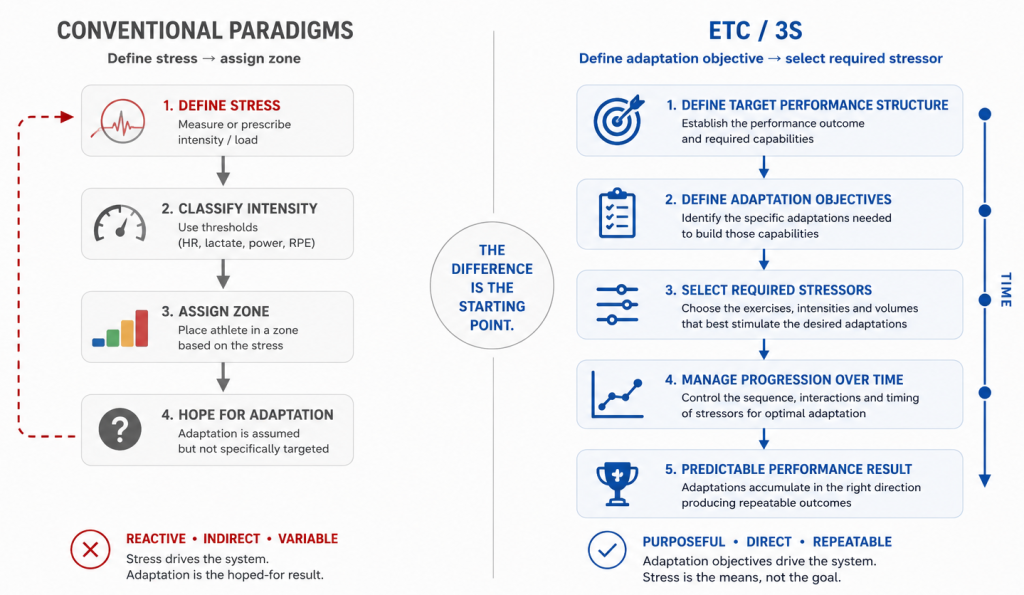
The Key Organizational Differences Between Paradigms: Shift in Thinking Process
Under the “conventional” (Current) Paradigms, the structure is limited to “define stress → assign zone”.
However, under the ETC/3S View, the structure starts from the adaptation objective before we select the required stressor.
This means that the intensity level (“stress factor”) is actually a secondary parameter and depends on the objective we try to address at any given time.
What This Difference Means for Coaches
Once training is viewed through the ETC paradigm, the organizational logic of the training process changes fundamentally:
- exercises become targeted stressors,
- zones become adaptation objectives,
- stress becomes a controlled consequence rather than the primary driver,
- and coaching becomes management of progression over time.
If nothing else, and returning to Dr. Harnish’s sentiment regarding “fragmented language” that fails to connect the professional community, it is painfully clear that this task is hardly attainable under the existing training philosophies, in which the connection between training structure and performance outcomes is fundamentally broken.
Clearly, to solve this problem, we need to look at our conventional views on training from the “outside” and, most likely, radically change them.
And I do not believe this requirement is optional anymore.
Entering A New Technology Era
Our world is already changing rapidly through the use of structured models across science, technology, and decision-making systems. The rapid emergence of AI-driven systems is further accelerating this transition by increasing the value of structured, model-based approaches over fragmented, experience-driven methods.
Training methodology is already undergoing the same transformation, and ETC is at the forefront of this change.
Additionally, this evolution is being amplified by the major technological changes reshaping the world today.
The early adopters will thrive on the results they can demonstrate through systems built on ETC principles, such as 3S. Older organizational models will increasingly struggle to explain, predict, and manage modern performance demands.
The question remains: which side are you on?
Or perhaps the real question is whether you already recognize this shift and are prepared to move with it.
See how coaches and athletes using 3S applied this structured approach to produce measurable results across rowing and swimming.