The Ergometric Training Concept
A Framework for Structuring the Training Process and the Design of Performance
Performance is not a reaction.
It is a process.
Training is not a collection of methods.
It is a structured process of change over time.
The Limitation of Modern Training Practice
Over the past several decades, sports training has been shaped by advances in physiology, biochemistry, and performance measurement.
These disciplines have significantly improved our understanding of how the human organism responds to training load.
As a result, modern training includes intensity zones, lactate measurements, interval methods, and periodization models.
However, despite this progress, one fundamental problem remains unresolved.
In practice, training is organized as a combination of partially connected elements.
Even when based on sound science, these elements do not form a unified system.
- inconsistent outcomes
- reactive decision-making
- unpredictable performance development
This limitation does not arise from a lack of scientific knowledge.
It arises from the absence of a unifying principle.
The Emergence of the Ergometric Training Concept
The Ergometric Training Concept was not developed as a theoretical model.
It emerged from more than two decades of applied work through the 3S system.
The system demonstrated consistent results across multiple sports.
However, one critical issue remained: the system existed in practice, but lacked formal definition.
Its principles were not explicitly articulated. Its structure was not formally described.
By 2025, the need for formalization became evident. The Ergometric Training Concept represents this formalization.
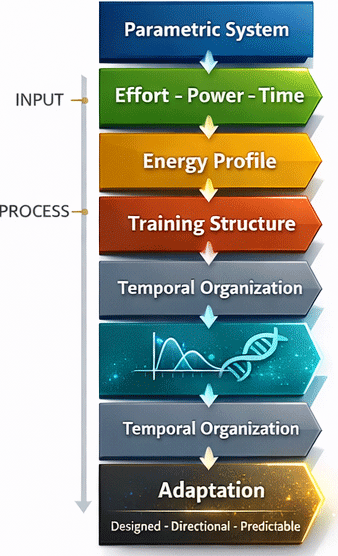
Training is not a collection of methods.
It is a process.
Training is a controlled transformation of the athlete’s condition over time, defined by the relationship between load, time, and adaptation.
Time as the Organizing Dimension
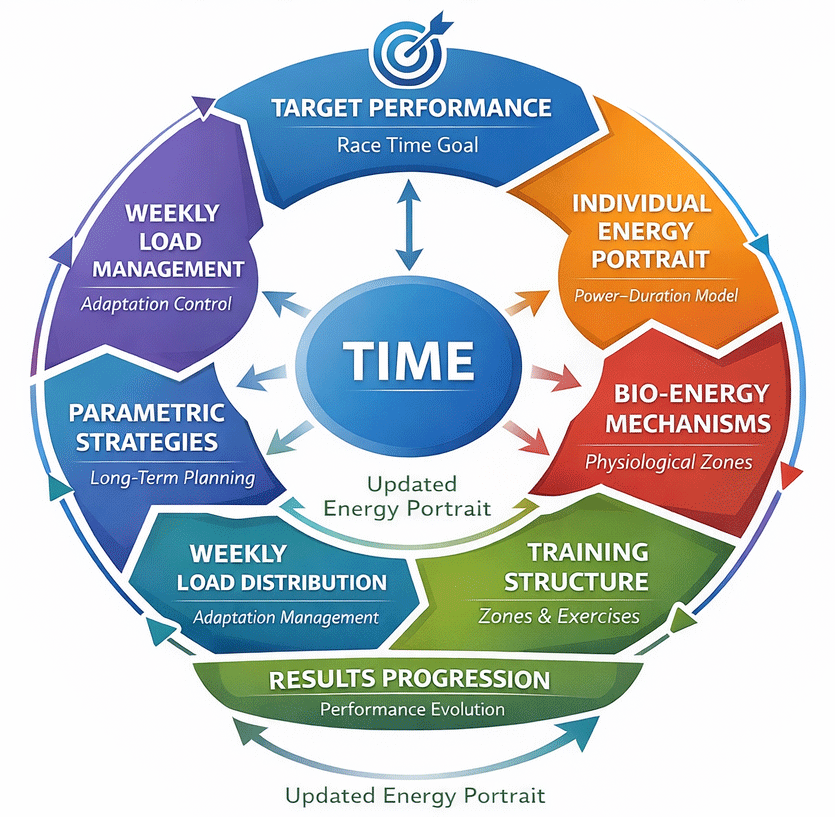
Time is not just a parameter. It is the central organizing dimension of training.
Time defines duration of effort, cumulative exposure, load distribution, and performance measurement.
Through time, all elements of training become unified.
Adaptation as a Structured Process
In conventional models, adaptation is treated as a reaction to individual sessions.
In reality, performance does not develop through isolated reactions.
Adaptation results from repeated exposure to structured loads over time.
Parametric Training as a Structural Foundation
Parametric principles define how different load structures produce predictable adaptations.
These principles were established in the late 1970s, but were not widely adopted due to conflicts with dominant models such as lactate-based regulation and classical periodization.
Despite their significance, they remained largely absent from systematic coaching practice.
Within 3S, these principles were preserved, developed, and applied.
The Ergometric Training Concept formalizes their role.
Structure Through Transitional Variables
The concept introduces transitional variables that connect major elements of the training process.
Power ↔ Duration
Intensity ↔ Time
Load ↔ Recovery
Exercise ↔ Effect
Training is no longer a set of exercises. It becomes a structured system of relationships.
The Role of Physiology and Coaching
Physiology allows us to evaluate condition, identify limitations, and define targets.
However, physiology does not define the process of transformation.
- Training is a methodological and pedagogical process.
- The athlete is dynamic, adaptive, and capable of learning.
- Coaching becomes guidance of structured development.
The Problem of Coaching Legacy
Great coaches produce great results. But their knowledge is rarely transferable.
Their logic is implicit, undocumented, and non-reproducible.
When they leave, their methods disappear.
The 3S Contribution
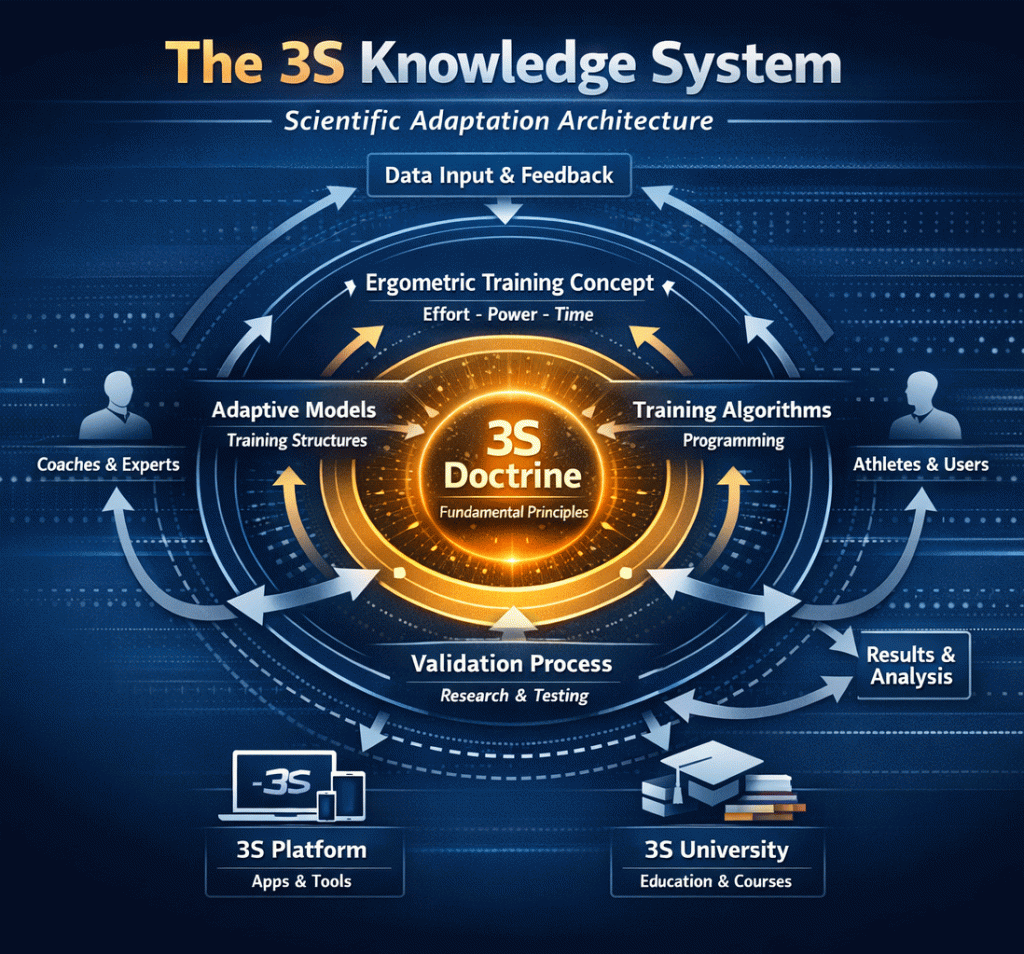
3S makes it possible to capture training logic, analyze structure, compare it against models, and reproduce decisions.
Structure of the Training Process
Evaluation
Target Definition
Load Structuring
Execution
Monitoring
Adjustment
This cycle is continuous. Its effectiveness depends on structure and consistency.
Performance is not the result of isolated reactions.
It is the outcome of a structured and directed process.
The Ergometric Training Concept defines this process. It allows performance to be designed.